

Fashion's unequal exchange
Who pays, and who cashes in?


Image: Installation by Chilean artist Cecilia Vicuña, ‘Quipu Womb (The Story of the Red Thread)’, 2017 (source)
Since September last year, I’ve been studying for a (part-time) Master's degree at Universitat Autònoma de Barcelona in Degrowth: Ecology, Economics and Policy. The course, filled with teachers, entrepreneurs, farmers, artists, scientists, and activists, covers a huge range of topics under the degrowth umbrella, from environmental justice, ecological economics and ecofeminism to the history of capitalism, urban planning and the sociology of what gives life meaning. It’s fascinating, and overwhelming. My interest in degrowth, as a means, as an ends, and in particular as a lens for understanding the fashion industry, has long lingered beneath my work. But as systems of power are increasingly being unmasked and upended, this course has connected the dots further still.
I still have far more questions than answers, and feel less confident than I probably ever have about sharing my thoughts publicly, but this seems like a good place to start sowing some seeds again. With that in mind, let’s explore where things currently stand on degrowth and fashion.
A recap - what is degrowth?
Degrowth is, in short:
A critique of the global capitalist system which pursues economic growth at all costs
A proposal for a new economic system which prioritises social and environmental wellbeing
This description (abridged here), which does not use the label ‘degrowth’, offers a broad overview of what degrowth entails. It was recently shown to more than 5000 people in the UK and USA, and 82% of these people said they support it!
On the one hand, high-income countries must scale down non-essential forms of production and consumption to achieve faster decarbonization and reverse various forms of ecological damage (e.g., biodiversity loss). This includes reducing things like SUVs, private jets, mansions, luxury goods, industrial meat, advertising, and fast fashion; cutting the purchasing power of the very rich; shifting from private cars to public transit; ending the practice of planned obsolescence by designing products that last longer; and extending product lifespans through repair and reuse.
On the other hand, social progress and human well-being must be improved by ensuring universal access to high-quality public services (e.g., healthcare, education, public transit, childcare), affordable housing, and living wages. A public job guarantee, where the government guarantees employment to those willing and able to work, would end unemployment and empower people to contribute to the most important projects of our generation: building renewable energy capacity, improving public transit, insulating homes, and regenerating ecosystems.
Crucially, this economic system would have an impact beyond the high-income countries where it would be implemented. Currently, the overuse of resources in these countries is sustained through the unfair appropriation of resources from the Global South. As a consequence, the countries in the Global South are more susceptible to various detrimental environmental and social consequences (e.g., biodiversity loss, poverty) and are drained of resources that are necessary for human development. The economic system we are describing is about ending this process of plunder. It calls for a fairer international economy so that all people on the planet can achieve decent living standards within planetary boundaries.
Fashion is often cited as both an archetype of the destructive growth system, and as a key sector for potential cultural change to the contrary (see Kate Fletcher and Mathilda Tham’s ‘Earth Logic’ and Sandra Niessen’s ‘Defashion’).
Unequal exchange: Fashion’s foundation
The term ‘unequal exchange’ is an economic concept that describes the capture and transfer of a vastly disproportionate amount of labour and natural resources from the so-called ‘periphery’ (Global South) to the so-called ‘core’ (Global North). In this system, core nations enjoy surplus value while peripheral nations suffer surplus costs.
In a basic sense this is very obvious for the fashion industry - think of it like a T-shirt being sold in Europe for 20 euros, while just 5 euros has been paid to workers and for raw materials in Asia. In this case, Europe has net-appropriated 15 euros worth of value from Asia. Most importantly for this concept, rather than those labour hours and kilograms of cotton being used to meet local clothing needs, or reorientated to other socially necessary production, they have been used to fulfil the desires of Western consumers, without sufficient payment to remedy the social and environmental impacts of producing that T-shirt.
The fashion industry as we know it is built on this unequal exchange, with a long and shameful history of chasing the lowest possible labour costs (with slavery of course, this became zero), and the weakest possible environmental regulations, to extract maximal profit for any given textile product.
Which brings us to an excellent new report from Research & Degrowth International and War on Want, Extraction Fashion: Unequal Exchange and Degrowth Explored. Here’s the always brilliant Tansy Hoskins with an overview:

The report aimed to quantify the material footprint of the fashion industry in 2021 to demonstrate the frankly insane amount of resources used to make clothing that we mostly do not need, benefiting the few at the cost of the many. For example:
The land used to fulfil EU fashion consumption amounted to 226,927.80 square kilometres. 90% of this land is in Asia and Africa, not Europe.
The fossil fuels used to fulfil EU fashion consumption amounted to 40,976 kilotons, plus 45,889 kilotons of metals and 189,261 kilotons of minerals, mostly from China.
The freshwater used to fulfil EU fashion consumption amounted to 5.45 billion cubic meters, mostly from Asia, Africa and the Middle East.
The report also measures the many millions of labour hours it takes to fuel fashion consumption, again showing clear patterns of unequal exchange. Its data suggests that 90% of labour hours embedded in EU fashion consumption in 2021 are in China, India and ‘Rest of Asia'. The report notes that: “Every one of these hours spent in a factory in China, India, Indonesia or Turkey is an hour not used for family and care work, practising agroecology (sustainable farming that works with nature) for domestic manufacturing for local fashion industries, for people’s material needs of food and natural goods, building flood defences, protecting and restoring habitats, education, health, community building and political engagement as well as rest, leisure, music, literature and creativity.”
These trends reflect the findings of this study which concluded that across all sectors, the Global North net-appropriated 826 billion hours of embodied labour from the Global South in 2021, with a wage value of €16.9 trillion euros.
In other words, this is not ‘news’, and it is not fashion-specific (read A History of the World in Seven Cheap Things for a much broader explanation of the topic), which means we cannot view this sector in isolation from the bigger picture of the world economy. This is why the dominant individual brand-driven approach in fashion is a totally unsuitable frame for exploring degrowth, even when great examples of post-growth inspired business models and grassroots practices abound.
So what do we do about this wicked problem?
With that big-picture approach in mind, I don’t have space here to explore the massive range of (often contradictory) proposed solutions to fashion’s relationship to unequal exchange, but the Extraction Fashion report’s conclusion is a good baseline to understand the mammoth global political changes (ie. ‘delinking’) that would need to happen to make it possible to de-grow fashion in the first place:
“A just, equitable and ecological transition along degrowth lines means removing the barriers for countries currently locked into fashion exports as their economic lifeline to make genuinely sovereign decisions about economic development….fundamentally, a rebalancing of global economic power - through a fair shares approach and reform of debt, trade, tax regimes…The fiscal freedom for countries in the Global South to enact their own alternative low-carbon and green industrial economic strategies would constrain the fashion industry’s ability to extract so relentlessly for profit - as instead those natural goods and human labour would become organised to provide for the material needs of their people without perpetuating cycles of climate breakdown, environmental degradation, poverty and inequality.”
Again, no answers, just more questions. But maybe we can at least agree on a starting point, a fundamental common sense that, according to Anne Oudard writing for Cotton Diaries on Substack, “responsible sourcing strategy without systems change is just gardening”.
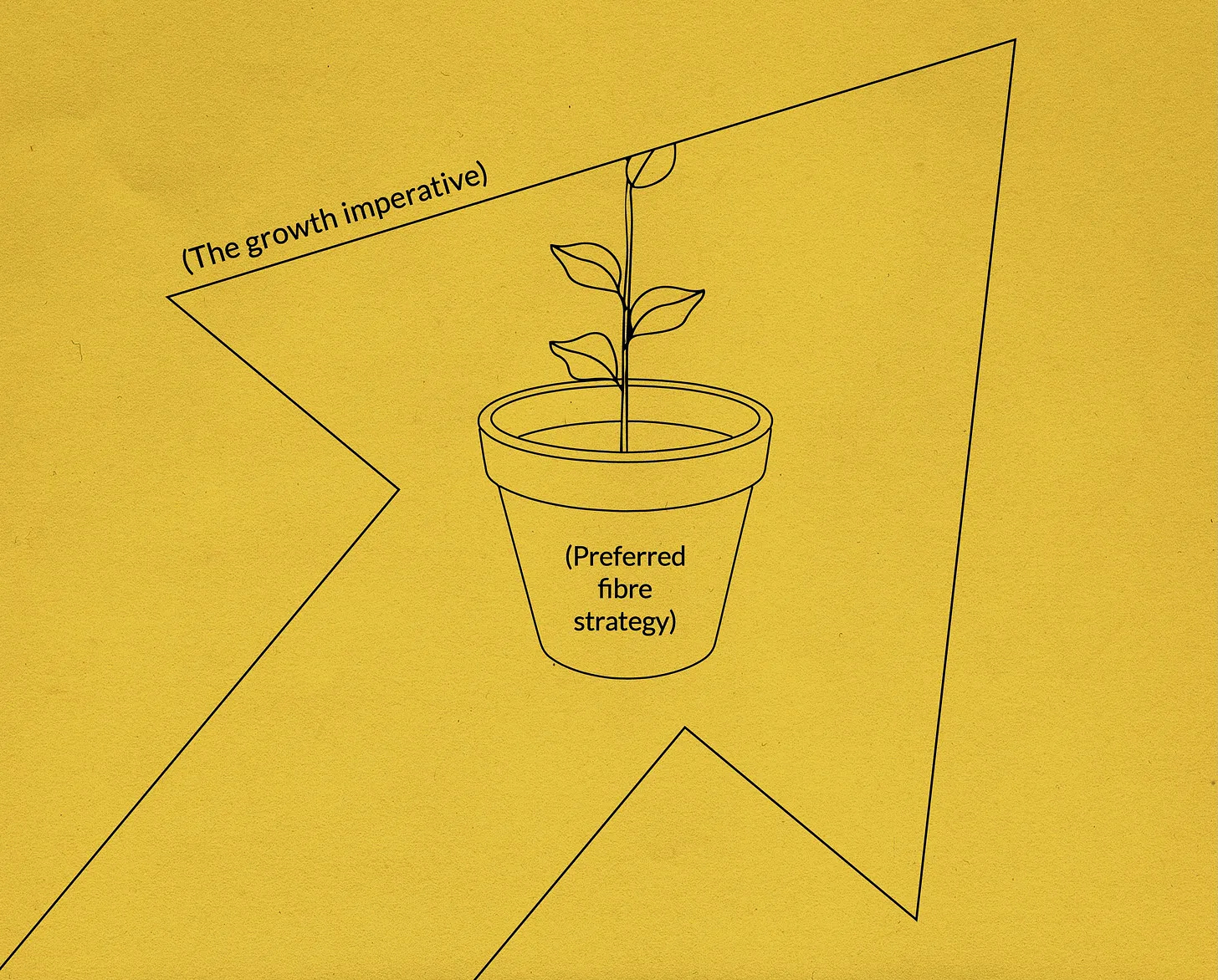
Image source
Finally, if the topic of post-growth fashion sparks your interest, I highly recommend subscribing to Katia Dayan Vladimirova’s Post Growth Fashion, a fountain of excellent resources and thought-starters from academia and beyond.
One quote
“Because I want to know! Sometimes, you can use what you know, but that’s not what counts most. I want to know everything there is to know. Not because it’s any use, but for the pleasure of knowing, and now I demand that you teach me everything you know, even if I will never be able to use it.”
― Jacqueline Harpman, I Who Have Never Known Men
Three links:
I’ve been listening to a lot of Planet Critical recently, in large part for the skill of the interviewer, Rachel Donald, who really challenges her guests (and listeners!)
The Rana Plaza Solidarity Collective are protesting in London on 28th March as a ‘Fashion against Fascism’ bloc at the Together March
Grace Blakeley’s Substack is great. Give this a read:
I’ll also leave you with this (very lo-fi) short film I made with some fellow classmates about textile waste as an environmental justice issue in Accra, Ghana. It follows the global textile waste stream, its impacts on communities, and some proposed solutions from the field of degrowth and unequal exchange. It includes an interview with James Mensah.
Ruth I'm so pleased that you're on this course. I'm also super interested in how de-growth models can create a more equitable and sustainable system for consumer business. It's something I feel strongly about, but with the industry not only linear, but also within a traditional capitalist economic model, I struggle to see how we will encourage this change. I would love to discuss with you at some point and look forward to reading more of your learnings and thoughts on the subject.
First of all, the course you’re on sounds fascinating (I’m very jealous!!)!
I’m definitely going to read up on that report. Degrowth has to be the future of fashion and so it’s such a joy to see people talking about it 🌍🤍